
10 Best Developer Portfolio Examples That Get Hired
Key Takeaways
- The best developer portfolio examples all share a few core traits: clear storytelling, focused project selection (3–6 projects), and fast load times
- Case studies beat project lists — explain what you built, why, and what you learned
- Design restraint is a skill: clean, minimal portfolios consistently outperform flashy ones
- Mobile responsiveness is non-negotiable; recruiters check on their phones
- Your portfolio must load in under 2 seconds or hiring managers will bounce
- AI tools like Portfolio Studio can help you generate a polished, hire-ready portfolio in minutes
Looking for portfolio inspiration that actually translates into interviews? You’ve come to the right place.
In this post, we break down 10 of the best developer portfolio examples used by working developers in 2026 — not to copy them wholesale, but to understand why they work. Each one does something differently well, and by the end you’ll have a clear model for what your own portfolio should do.
What Makes a Developer Portfolio Stand Out?
Before diving into specific best developer portfolio examples, let’s establish what separates a portfolio that gets callbacks from one that gets ignored.
According to research from LinkedIn’s Talent Solutions team, over 70% of hiring managers say they check a candidate’s online presence before making a decision. A portfolio isn’t a nice-to-have — it’s the first impression you make before the interview.
Strong portfolios tend to share these traits:
- 3–6 focused projects with context and live links (not 20 vague GitHub repos)
- Case studies that explain the problem, your role, and the outcome
- Fast loading — under 2 seconds, every time
- Clean, professional design that doesn’t distract from the work
- Clear contact information and a visible call to action
Now, let’s look at real examples that check all these boxes.
10 Best Developer Portfolio Examples (With Breakdowns)
1. Brittany Chiang — The Gold Standard for Minimalism
Brittany Chiang’s portfolio is probably the most referenced example in developer communities — and for good reason. It loads in milliseconds, uses a dark theme with strategic green accents, and leads with exactly what a recruiter needs: name, current role, and a one-sentence value proposition.
What makes it work:
- The “Featured Projects” section shows only 4 projects, each with a screenshot, tech stack chips, and links to both the live site and GitHub
- The “Other Noteworthy Projects” grid adds depth without clutter
- Every animation is purposeful — hover effects guide the eye without being distracting
The lesson: Curation beats quantity. Brittany doesn’t list every side project she’s ever touched. She picks her best work and gives each project room to breathe.
2. Josh W. Comeau — Case Studies Done Right
Josh W. Comeau is a former Gatsby and Khan Academy engineer who turned his portfolio into a content engine. His site is warm, playful, and packed with proof of expertise.
What makes it work:
- Each project entry reads like a mini case study — what he built, the interesting technical challenge, what he’d do differently
- His writing voice is consistent throughout, making the whole site feel personal and authentic
- He publishes detailed blog posts explaining techniques, which demonstrate deep knowledge far more effectively than a skills list
The lesson: Writing about your work is one of the most underrated portfolio strategies. A 500-word case study on how you optimized a React component for performance signals more expertise than “React: 3 years.” This is exactly what we explore in our guide on how to build a developer portfolio website.
3. Sara Soueidan — Authority Through Specificity
Sara Soueidan is an SVG and accessibility specialist, and her portfolio makes that crystal clear within seconds. Her “specialization” framing is a masterclass in personal branding.
What makes it work:
- Instead of claiming to be a “full-stack developer who knows everything,” Sara stakes a specific claim: SVG, front-end performance, and accessibility
- Her speaking and writing sections show industry authority
- Testimonials from respected figures in the field add powerful social proof
The lesson: Niching down makes your portfolio more memorable, not less hireable. Hiring managers filling a specific role are more likely to contact “the accessibility expert” than “another React developer.”
4. Adham Dannaway — The Split-Screen Personality
Adham’s portfolio opens with a split-screen animation showing his design self on one side and his coding self on the other. It’s clever, fast-loading, and immediately communicates his dual skillset.
What makes it work:
- The interactive hero section demonstrates his skills in the act of experiencing it — no description needed
- Clean white space throughout keeps the focus on work, not decoration
- The projects section clearly labels each one as either design, development, or both
The lesson: Your portfolio’s design is itself a portfolio piece. If you can do something interesting in the hero section that shows what you do, that’s far more convincing than any headline you can write.
5. Kent C. Dodds — The Authority Portfolio
Kent is a prolific educator and open-source contributor, and his portfolio reflects that. It’s less of a traditional portfolio and more of a hub for everything he creates — blog posts, courses, talks, and open source.
What makes it work:
- The site clearly segments his different audiences: employers, learners, event organizers
- Deep linking to conference talks, podcast appearances, and popular articles demonstrates credibility at scale
- His technical writing alone has earned him enough authority that “Kent C. Dodds” is a recognizable name in the JavaScript community
The lesson: As you grow your career, a portfolio evolves into a content platform. Start simple, then layer in writing, talks, and community contributions over time.
6. Wes Bos — Product-Driven Developer Portfolio
Wes Bos built his portfolio around his products: JavaScript courses that have taught hundreds of thousands of developers. The portfolio works because the products speak for themselves.
What makes it work:
- Clear evidence of real-world impact (enrollment numbers, testimonials, podcast stats)
- A consistent, recognizable personal brand that makes him immediately identifiable
- Simple tech stack: the site focuses on making his work visible, not on showing off frameworks
The lesson: If you have results — users, revenue, testimonials, GitHub stars — lead with them. Developer portfolio ideas that showcase real-world impact stand out far more than portfolios that only describe technologies used.
7. Dejan Markovic — Purposeful Animation
Dejan’s portfolio uses subtle, smooth animations that load progressively as you scroll. It’s visually impressive without feeling over-engineered, which is a hard balance to strike.
What makes it work:
- Animations reinforce the message (each element slides in as it becomes relevant) rather than existing for their own sake
- Despite the visual richness, load time remains under 2 seconds
- His project cards show clear before/after or problem/solution framing
The lesson: Animation is fine — even good — when it’s purposeful. But if removing it would make the site faster and easier to navigate without losing any information, it probably shouldn’t be there.
8. Charlie Gerard — Learning in Public
Charlie Gerard built her portfolio around exploration and experimentation, documenting projects that use unusual browser APIs, machine learning models in the browser, and creative tech.
What makes it work:
- Each project tells a story of curiosity — “I wondered if X was possible, so I tried it”
- Linking to conference talks and writeups adds credibility and depth
- Her projects stand out because they’re not just CRUD apps — they demonstrate genuine technical curiosity
The lesson: For developers early in their career, curiosity projects are underrated. Building something weird — a mood tracker using your webcam, a gesture-controlled music player — signals the kind of creative problem-solving that teams actually want to hire.
9. Matt Farley — Client-Focused Clarity
Matt Farley’s portfolio is a strong example of targeting a specific audience: business owners who need web development work, not other developers. His site speaks entirely to the outcomes his clients care about.
What makes it work:
- The headline is all about client outcomes: faster sites, better conversion, more leads
- Case studies show measurable results (page speed before/after, conversion rate improvements)
- Testimonials appear above the fold — not hidden at the bottom
The lesson: Portfolio design should match your audience. If you’re going freelance, speak the language of clients (outcomes and ROI), not other developers (tech stacks and patterns). Portfolio examples 2026 show an increasing focus on results-oriented framing.
10. A Minimalist Full-Stack Portfolio — The 4-Section Formula
Rather than pointing to one individual, this final example captures a pattern seen across dozens of the most effective developer portfolio examples in 2026: the 4-section formula.
The structure:
- Hero — Name, one-line value prop, and a clear CTA (“View my work” or “Download resume”)
- Projects — 3–5 cards with title, description, tech stack, live link, and GitHub link
- About — 100–150 words, professional headshot, skills with context
- Contact — Email, LinkedIn, GitHub, and a simple contact form
This structure is simple, fast, and effective. It doesn’t try to be clever — it just answers the three questions every recruiter asks: Who are you? What can you build? How do I reach you?
The lesson: Simple done well beats complex done poorly. Most developers who struggle to build a portfolio overthink it. Start with these four sections and ship.
Common Patterns in the Best Developer Portfolio Examples
Looking across all 10 developer portfolio examples above, a clear picture emerges.
They all have:
- A specific, clear value proposition in the hero section
- Projects with context — not just titles and links
- Fast load times (the technical implementation is solid)
- A way to contact them that’s easy to find
None of them have:
- A skills section listing every technology they’ve ever touched
- Placeholder copy like “Lorem ipsum” or “Coming soon”
- Auto-playing music or videos
- Generic “I’m passionate about coding” bios
Design choices that appeared across the best portfolios:
- Dark backgrounds with accent colors — commonly green, blue, or orange
- Typography-first layouts — large, readable headings with good line spacing
- Scroll-triggered animations — subtle, not distracting
- Project screenshots or mockups — not just text descriptions
Turning Portfolio Inspiration Into Your Own Site
Studying the best developer portfolio examples is only useful if it changes what you build. Here’s how to translate these examples into action:
If you’re looking for more raw inspiration, the developer-portfolios GitHub repository curated by Emma Bostian has hundreds of real examples to browse.
Step 1: Pick your 5 best projects. Not your 15. The ones you’re most proud of and can speak to in an interview.
Step 2: Write a case study for each. Answer: what was the problem? What did you build? What was your specific role? What would you do differently?
Step 3: Write a human bio. Not a list of technologies. Tell the story of how you got into development and what kind of problems you like to solve.
Step 4: Choose a design direction. Minimal is almost always the right choice. Pick one accent color and stick with it.
Step 5: Ship it. A live portfolio with 3 projects beats a perfect portfolio that’s 80% done.
The Fast Path: Let AI Build the Foundation
If you’ve been putting off building your portfolio because it feels like too much work, there’s a faster path. Portfolio Studio uses AI to generate a complete, professional portfolio from your resume and project descriptions — in minutes, not weeks.
It handles the design, layout, and structure while you focus on what actually matters: the story behind your work. You can start from an AI-generated foundation and customize from there, rather than staring at a blank page.
Frequently Asked Questions
How many projects should I include in my developer portfolio? 3–6 projects is the sweet spot. More than that and recruiters can’t tell which projects matter most. Fewer than 3 and it may look like a thin body of work (unless each project is substantial).
Should I include projects I built in a bootcamp or course? Yes, with honesty. Label them clearly (“Built during [Course Name]”) and focus your description on what you learned and what you’d extend next. They’re better than nothing — just don’t lead with them.
Does my portfolio need to be original design? No. Using a template or a tool like Portfolio Studio is completely acceptable. Recruiters care about your work, not whether you hand-coded your portfolio CSS. That said, make sure it looks professional and represents your standards.
How often should I update my portfolio? At minimum, update it when you start a job search. Ideally, add new projects as you finish them and remove outdated ones. A portfolio with projects from 5 years ago and no recent work raises questions.
Build Your Portfolio Today
The best developer portfolio examples share one thing beyond design and structure: they exist. They’re live, they’re indexed by Google, and they’re waiting when a recruiter searches for candidates.
Studying portfolio inspiration is useful. But at some point, you have to close the tab and build your own.
Ready to build your portfolio? Try Portfolio Studio free — generate a professional portfolio from your resume in minutes, then customize it to reflect your best work. →
Ready to build your portfolio?
Create a professional portfolio website in minutes with AI. No coding required.
Try Portfolio Studio FreeRelated Articles
UX Design Portfolio Examples: 9 Patterns That Stand Out in 2026
Use these UX design portfolio examples and patterns for inspiration. Learn what effective UX portfolios include and what hiring teams actually want to see.
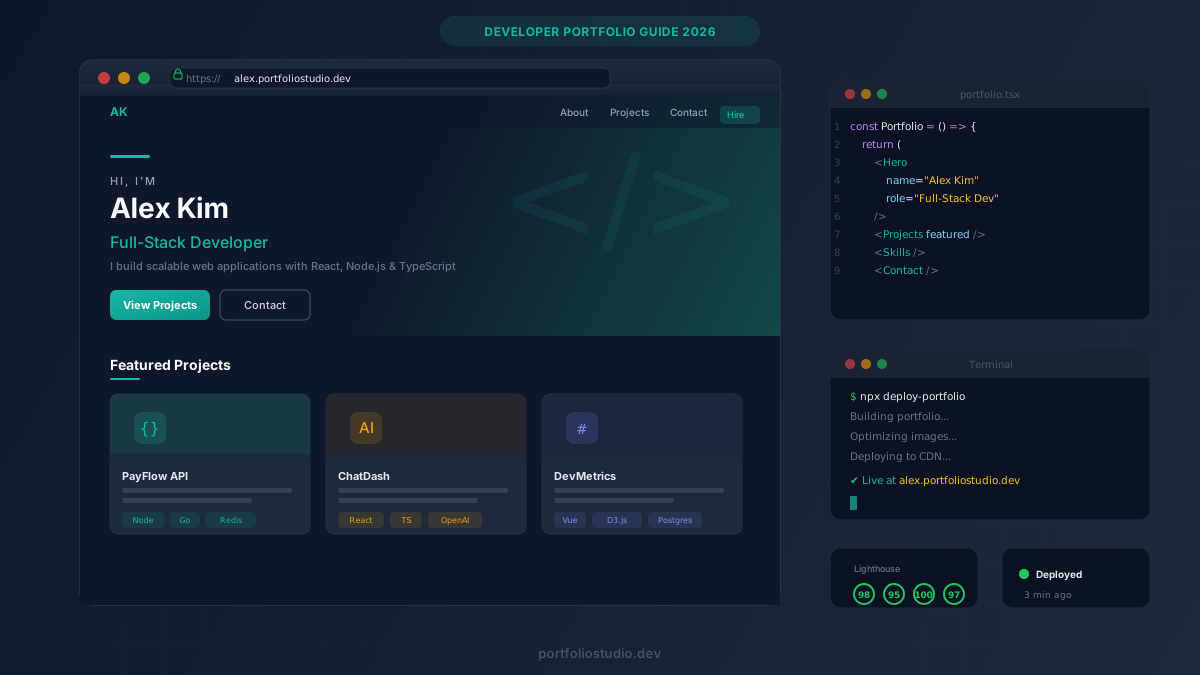
How to Build a Developer Portfolio Website in 2026
Learn how to build a developer portfolio website that gets you hired. Step-by-step guide covering structure, content, design, and deployment.
Portfolio Website Mistakes That Cost You Interviews
Avoid the portfolio website mistakes that make recruiters, clients, and hiring managers lose trust before they understand your best work.