
Product Manager Portfolio: What to Include When You Do Not Have Visual Work
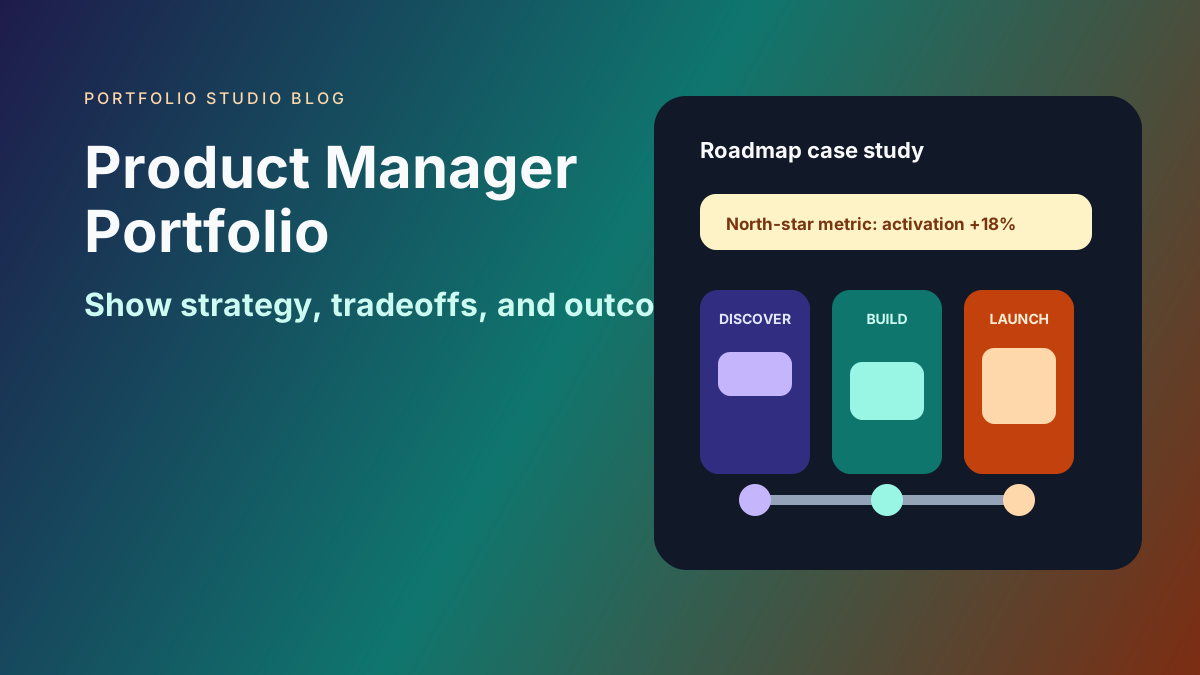
Key Takeaways
- A product manager portfolio should show how you think, decide, prioritize, and measure outcomes
- PM portfolios do not need to look like design portfolios
- Strong PM case studies explain the problem, customer insight, tradeoffs, launch decisions, and results
- Confidential work can be presented safely by anonymizing details and focusing on process and impact
- A clear portfolio can support interviews, networking, and senior career moves
Product managers often struggle with portfolios because their work is not always visual.
Designers can show screens. Engineers can link to code. PMs often work through strategy documents, discovery notes, roadmaps, metrics, alignment, and tradeoffs. That work is valuable, but it needs translation.
A product manager portfolio is the place to show the thinking behind your product decisions. It should help a hiring manager understand how you identify problems, work with teams, and deliver outcomes.
If you are building a broader professional site, read Portfolio Website for Professionals.
Do Product Managers Need Portfolios?
Not every PM role requires a portfolio, but a strong one can help when your resume does not capture the depth of your work.
A portfolio is especially useful if you:
- Are moving into product management
- Want to show strategic thinking
- Have complex projects that need context
- Are applying for competitive PM roles
- Want to support interview conversations with concrete examples
The goal is not to create a decorative site. The goal is to make your product judgment easier to evaluate.
What a PM Portfolio Should Show
A product manager portfolio should communicate:
- Customer understanding
- Problem framing
- Prioritization approach
- Cross-functional collaboration
- Decision-making under constraints
- Product metrics
- Business impact
- Lessons learned
This is different from simply listing features shipped. Shipping is only part of the story. Explain why the work mattered.
Use Product Case Studies
Most PM portfolios should center on three to five case studies.
Use this structure:
- Context - What product, market, or customer segment was involved?
- Problem - What was not working?
- Goal - What outcome were you trying to improve?
- Discovery - What customer, data, or stakeholder input shaped the work?
- Tradeoffs - What options did you consider?
- Decision - What did the team build or change?
- Outcome - What happened after launch?
- Reflection - What would you do differently now?
This structure works for launches, growth experiments, onboarding improvements, pricing changes, platform work, internal tools, and failed experiments.
What If Your Work Is Confidential?
Most PMs deal with confidential information. You can still build a useful portfolio.
Use safe framing:
- Replace company names with categories
- Use approximate scale instead of exact numbers
- Describe methods without revealing proprietary details
- Focus on decisions and lessons, not internal documents
- Remove screenshots if they expose sensitive product information
For example, “improved activation for a B2B SaaS onboarding flow” can be enough if the case study explains the product problem and your role.
Include Product Artifacts Carefully
You can include artifacts, but only when they clarify the story.
Useful artifacts include:
- Roadmap excerpts
- Prioritization matrices
- User journey maps
- Experiment plans
- Metrics dashboards
- Launch checklists
- Research summaries
- Before-and-after flows
Do not upload internal documents as-is. Recreate simplified, sanitized versions if needed.
Add a Product Philosophy Section
A short product philosophy can help if it is specific.
Avoid generic lines like “I love building products users love.” Instead, explain how you make decisions.
Examples:
- “I prefer discovery that narrows risk before design and engineering commitment.”
- “I look for activation problems where small workflow changes can unlock meaningful behavior.”
- “I use roadmap planning to clarify tradeoffs, not to create false certainty.”
This helps your portfolio sound like a PM, not a template.
Common Mistakes
Making It Too Visual
A PM portfolio does not need flashy visuals. Clarity, structure, and judgment matter more.
Listing Features Without Decisions
“Launched feature X” is not enough. Explain why it was chosen and what happened.
Hiding the Metrics
Use metrics when you can. If exact numbers are confidential, use directional outcomes.
Ignoring Failed or Mixed Results
A thoughtful failed experiment can show strong product judgment if you explain what you learned.
Frequently Asked Questions
What should a product manager portfolio include?
Include a short bio, product case studies, product philosophy, selected artifacts, resume, and contact details.
Can PMs build portfolios without design work?
Yes. PM portfolios should focus on strategy, discovery, tradeoffs, metrics, and outcomes rather than visual design.
How many case studies should a PM portfolio have?
Three strong case studies are usually enough. Choose examples that show different product skills.
A product manager portfolio should make your judgment visible. It does not need to look like a gallery. It needs to show how you turn ambiguity into useful product decisions.
Ready to build your portfolio?
Create a professional portfolio website in minutes with AI. No coding required.
Try Portfolio Studio FreeRelated Articles
Data Science Portfolio Website: Turn Notebooks Into Case Studies
Learn how to build a data science portfolio website that turns notebooks, models, dashboards, and analysis projects into hiring-ready case studies.
Freelancer Portfolio Website: How to Win More Clients
Learn how to build a freelancer portfolio website that earns trust, explains your services, shows proof, and turns visitors into qualified client inquiries.

UX Research Portfolio: How to Show Impact Without Breaking NDA
Learn how to build a UX research portfolio that presents methods, insights, stakeholder influence, and product impact while respecting confidentiality.